Posts

Showing posts with the label Make

ATtiny Mario handset

Image
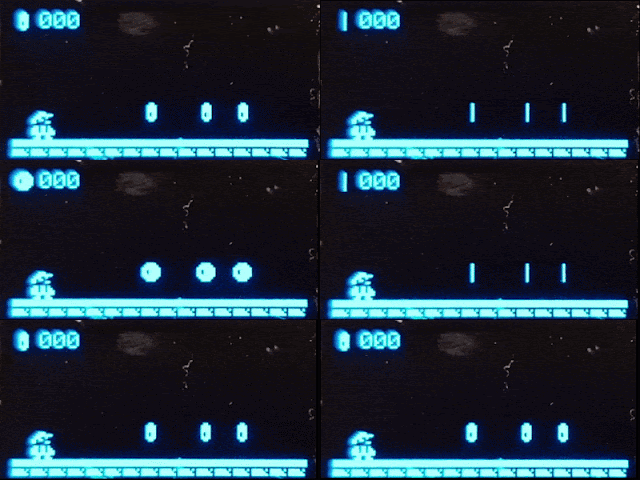
This is part 2 of my ATtiny Mario project - part one is here  -  a Mario-type game I made for the ATtiny85 AVR as a fun way of learning about the chip.  After writing the software, I decided I wanted a nice housing for the mass of wires on my breadboards and thought it would cool to put it into a NES-style controller, which is what this post will discuss.

ESP8266 low power DHT11 temperature and moisture remote sensor

Image
I have a problem with moisture in my loft.  After planning some intervention, I wanted a way to remotely monitor the humidity and temperature up there, and to visualise the data on a server.

PS2 controller as a radio controller!

Image
Turning a PS2 controller into a wireless radio controller with Arduino Mini and an nRF24l01 radio module I have previously described a project to transmit PS2 controller signals by radio .  The project featured an Arduino Nano that read the PS2 signals and transmitted them with an nRF24l01 module.  Recently I have been inspired to incorporate the battery, charging circuit and Arduino right into the controller - heavily inspired by this project here:

Litter tray TwitterBot - BeemoPoops!

Image
The Internet of cat litter trays - TwitterTray The world almost certainly doesn't need an internet-enabled litter tray that sends an amusing tweet every time my cat uses it.  But the world wasn't consulted, and got it anyway.  Follow Beemo the cat's poops at  https://twitter.com/BeemoPoops . Above:  "You've put a Twitter-what on my litter tray now?!" - Beemo, the cat in the hat.

The IR-egg: Voice-controlled ESP8266 I2S IR transmission!

Image
I recently posted on ESP8266: Minimum I2S code required for use I2S to accurately control output to a GPIO pin.  I also previously used a UART hack to use serial output to control an IR led .  This approach was a bit hacky though, requiring a few transmissions of the UART IR signal to get proper reception.  I thought that using the I2S protocol would be a really simple way of implementing an accurate IR signal transmission, modulated at 38 kHz.

Controlling my quadcopter with a PS2 controller

Image
I can now control my quadcopter with a PS2 controller - really cool!  The magic control box is powered either from the Arduino Nano inside and communicates with the quadcopter via radio, or a lipo battery, which is rechargeable over USB.  LEDs on the top feedback about the drone status and look really awesome. UPDATE: I have now incorporated the control electronics, and a long distance radio module directly into the PS2 controller!

Bluetooth programmer

Image
From breadboard to perfboard I have been busy bending Bluetooth modules to my will.  The typical parameters I need to control are the module name, baud rate, and whether the module is a slave or master.  To program my quadcopter over Bluetooth, I have defined a Bluetooth module as a Master, which connects automatically to the quadcopter slave module when available.  The Master module connects to the PC via an RS232 USB converter - until now this been a mass of wires living on a breadboard, but I've now finally soldered a simple circuit together to allow me to program modules more easily.

Wooden LCD clock make

Image
The obligatory re-housing LCD clock project! Something a bit different for this blog post.  No programming/electronics/hack blog would be complete without the obligatory (and I have to say, much maligned) taking-apart-an-LCD-clock-and-putting-it-into-a-pretty-box project!  So here's mine! I've had an old LCD clock sitting obediently on my project desk for a while now, diligently telling me how late it is and how I should really go to bed soon. Curiosity got the better of  me one afternoon and I took a small screwdriver to the whole thing and ended up with its guts on the desk in front of me.  The LCD screen itself is composed of a glass plate, embedded with the liquid crystal , various polarised filters, and a backing plane of a reflective foil.  Scrapping off the backing foil reveals a beautiful object - a piece of glass with lettering floating ethereally. This clock wasn't going back together in its original form, so my hand was pleasantly for...

Hand held PCB drill

Image
I was looking for a way to drill holes in home-made PCB boards.  It seemed that my only option wa investing in a rotary tool (i.e. Dremel) with a drill press.  However there seemed to be many forum discussions where a slight swing of the drill bit during lowering the drill press was causing a misalignment of drilled PCB holes.  Then I came across small 12V motors that had a drill bit attachment. Some have made their own drill presses for this.  Search Ebay or Amazon for "pcb drill press" and you'll be able to pick one up for a few pounds/dollars.  I soldered a small button onto the side of mine and, lo and behold!  A working, hand held PCB drill!  It's easy to find sets with the motor, drill attachment and several drill bits.  I found one with a set of 2 x 0.8, 0.9, 1.0, 1.1, 1.2, 1.3, 1.4 and 1.5 mm bits. So how does it fair?  I've hooked it up to a 9V battery and hey presto...: Those are mostly 1.0 mm holes I've drilled there and ...